

When Your Digital Transformation Starts Slipping Through Your Fingers…
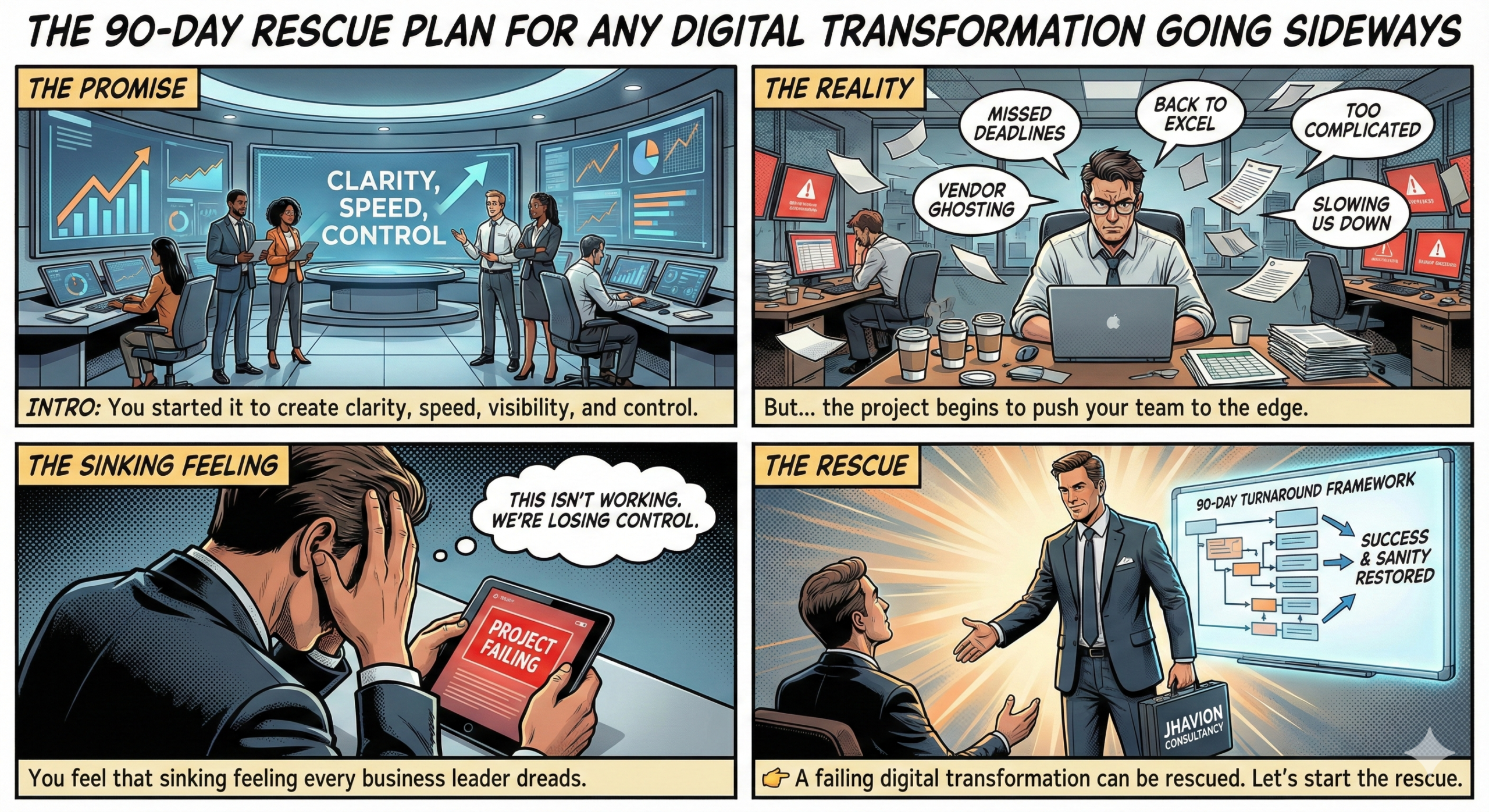
Every digital transformation begins with hope. You imagine a future where dashboards update in real-time, processes run automatically, teams collaborate effortlessly, and customers get faster, better service. You didn’t start your digital transformation to create chaos. You started it to create clarity, speed, visibility, and control. But somewhere between the demos, integrations, deadlines, and dashboards… the project that was supposed to transform your business slowly begins to push your team to the edge.
First, it’s a few missed deadlines.
Then the vendor stops picking up calls on time.
Your managers quietly revert to Excel “just for safety”.
Users start complaining:
“This is too complicated.”
“This doesn’t match how we work.”
“This is slowing us down.”
And one morning, you look at the project sheet and feel that sinking feeling every business leader dreads: “This isn’t working. We’re losing control.”
You’re not imagining it.
You’re not overreacting.
This is what a digital transformation looks like when it’s about to go sideways but here’s the part most companies never hear:
👉 A failing digital transformation is not a dead transformation. It’s a misaligned one — and it can be rescued.
Many of the most successful ERP and digital initiatives in the world were once on the verge of collapse. What saved them wasn’t luck — it was leadership, clarity, and a structured rescue plan.
A rescue plan that doesn’t take a year.
A rescue plan that doesn’t require scrapping everything.
A rescue plan that doesn’t depend on changing your entire vendor team.
A rescue plan that can turn everything around in 90 days.
At Jhavion Consultancy, we’ve stepped into projects that were bleeding money, confusing teams, and choking operations — and brought them back to life using a methodical 90-day turnaround framework.
It’s not a high-level strategy you’ll forget tomorrow. It’s the real roadmap we use when businesses call us and say:
“Please help… our ERP is falling apart.”
“Our team hates this system.”
“We’re not seeing ROI.”
“We cannot continue like this.”
If you’re reading this because your own digital transformation feels heavy, stuck, or directionless…
Then take a deep breath.
You’re about to see the exact steps that can save your project — and your sanity.
Let’s start the rescue.
Before the Rescue Begins: The Truth Most Companies Don’t Want to Admit
Every struggling digital transformation shares a similar pattern—not dramatic failures, but subtle misalignments that accumulate over time. Before we jump into the 90-day plan, there’s something important you need to hear — something most vendors, integrators, or internal teams won’t tell you:
👉 Digital transformations don’t fail suddenly. They fail silently.
In the early weeks, these issues look harmless: a small delay, a confused user, a vague requirement, a workflow that “we’ll refine later.” But as the project scales, these small gaps turn into major fractures. Here’s the reality many organizations overlook:
Digital transformations rarely collapse because of a single mistake.
They collapse because no one paused early enough to recalibrate.
They fail slowly, in small cracks that grow into giant gaps:
- A process that was never fully mapped and processes never documented or validated properly
- Multiple teams interpreting requirements differently
- A workflow that doesn’t match reality.
- A user who didn’t understand the training or Users trained on features, not real workflows
- A manager who stopped giving feedback.
- A vendor who promised everything but clarified nothing.
- Vendors configuring based on assumptions, not evidence
- Lack of clear ownership, governance, or escalation paths
- A leadership team that assumed “things are moving” until they weren’t.
None of these signs individually look like failure but together, they quietly push the transformation off its intended track.
Recognizing this is not about blame—it’s about control. Because once you identify & accept where misalignment began, you can course-correct with precision and that’s exactly what the 90-Day Rescue Plan is built for: a structured, time-bound recovery framework that restores clarity, resets expectations, and rebuilds momentum.
Phase 1 (Day 1–15): Stabilize the Project With a Rapid Diagnostic Audit
A failing digital transformation doesn’t need new features or faster development—it needs a clear picture of what went wrong. The first 15 days are dedicated to running a Rapid Diagnostic Audit, which gives leadership an accurate, unbiased view of the project’s current health. This phase focuses on three core areas:
Process Reality Check
We evaluate whether your actual business processes match what the system is designed to do. Most failing transformations show a gap here—sometimes a small mismatch, sometimes a complete disconnect. Deliverables include:
- Current vs. ideal process maps
- Identification of bottlenecks, redundancies, and broken workflows
- A list of processes that need redesign before further implementation
Technology Fit & Configuration Assessment
This is where we assess the system—not to blame the software, but to analyze whether:
- configurations align with real operations,
- integrations are stable,
- data structures are correct,
- and the system is scalable for future phases.
Common issues we uncover:
- Over-customization
- Weak data migration
- Unnecessary complexity
- Poor reporting structures
People & Change Readiness Analysis
A project may look technically sound but still fail due to user overwhelm or lack of adoption. We assess:
- User sentiment
- Training gaps
- Role-based usage patterns
- System dependency levels
This reveals whether people are confident, confused, or quietly resisting.
What You Achieve by Phase 1:
- A factual, unbiased overview of the project’s health
- A clear list of root causes—not symptoms
- Visibility into process, technology, and people misalignments
- Leadership clarity on what must be fixed, paused, or discontinued
- A realistic foundation for the next 75 days
Phase 2 (Day 16–45): Re-Align, Re-Design & Re-Map the Project Roadmap
Once the Phase 1 provide clarity on what went wrong, the next phase moves into structured correction. This is where the project stops feeling chaotic and begins to take a new, confident shape. Phase 2 focuses on rebuilding the foundation—processes, goals, expectations, and ownership—so the remaining implementation work begins on solid ground.
During these 30 days, your digital transformation moves out of “reaction mode” and into “strategic redesign.” Instead of trying to fix individual issues randomly, you create a unified framework that aligns your people, processes, and technology around a single direction. This is the phase where your project recovers its identity and purpose.
Re-Alignment: Getting Everyone Back on the Same Page
Most failing transformations suffer more from misalignment than from technical errors. In this phase, we bring all stakeholders—leadership, functional teams, end-users, IT teams, and vendors—into structured alignment sessions. These discussions achieve three critical outcomes:
- Everyone now understands the project’s true status—not assumptions, but real data from the diagnostic audit.
- The business vision, operational requirements, and user expectations are recalibrated into a shared set of goals.
- The vendor and internal teams receive clarity on boundaries, responsibilities, and approval structures.
When this alignment happens correctly, teams that were once frustrated begin to feel heard, supported, and re-committed to the project. This renewed clarity eliminates confusion and restores a sense of direction.
Process Re-Design: Simplifying, Standardizing, and Optimizing Workflows
With teams aligned, the next step is to rebuild the business processes that were causing friction. Instead of forcing software to fit outdated or inconsistent workflows, we reverse the approach: we fix the processes first, and then allow the platform to follow.
In this stage, unnecessary steps are removed, duplications are resolved, and approval chains are redesigned for speed and transparency. Complex workflows are simplified into clean, logical sequences that make sense not only for management, but also for the people who actually use the system every day.
This is often the most transformative part of the rescue plan. Once processes begin to flow smoothly on paper, teams immediately start to feel the difference—even before the technology is adjusted.
Technology Re-Mapping: Correcting Configuration and Creating a Scalable Model
With the new processes validated, the technology structure is redesigned. This includes revisiting configurations, simplifying customizations, adjusting data models, and ensuring the system supports the future—not just the current—needs of the business.
Instead of patching issues, this phase creates a clean blueprint that guides the technical team for the remaining implementation. Integrations, reporting frameworks, and user interfaces are aligned with the updated processes, reducing complexity and eliminating unnecessary technical debt.
By the end of this stage, the system’s technical roadmap is realistic, scalable, and directly connected to business outcomes.
Governance & Ownership: Defining How the Project Will Be Driven
A transformation cannot be rescued without proper governance. Phase 2 includes establishing clear ownership across departments, defining escalation paths, and setting up structured communication cycles. This ensures decisions are faster, accountability is consistent, and the project moves forward without confusion or dependency bottlenecks.
Leadership receives clarity on what needs their involvement and what can be delegated, while teams gain confidence knowing exactly where to go for approvals, changes, or support.
What You Accomplish by Phase 2
By the end of Phase 2, the transformation is no longer drifting. The project now has:
- A unified direction
- Clear processes
- Optimized workflows
- A stable technical blueprint
- Defined ownership and governance
- Teams who feel confident instead of overwhelmed
The project has shifted from uncertainty to structure—creating the momentum needed for successful execution in the final phase.