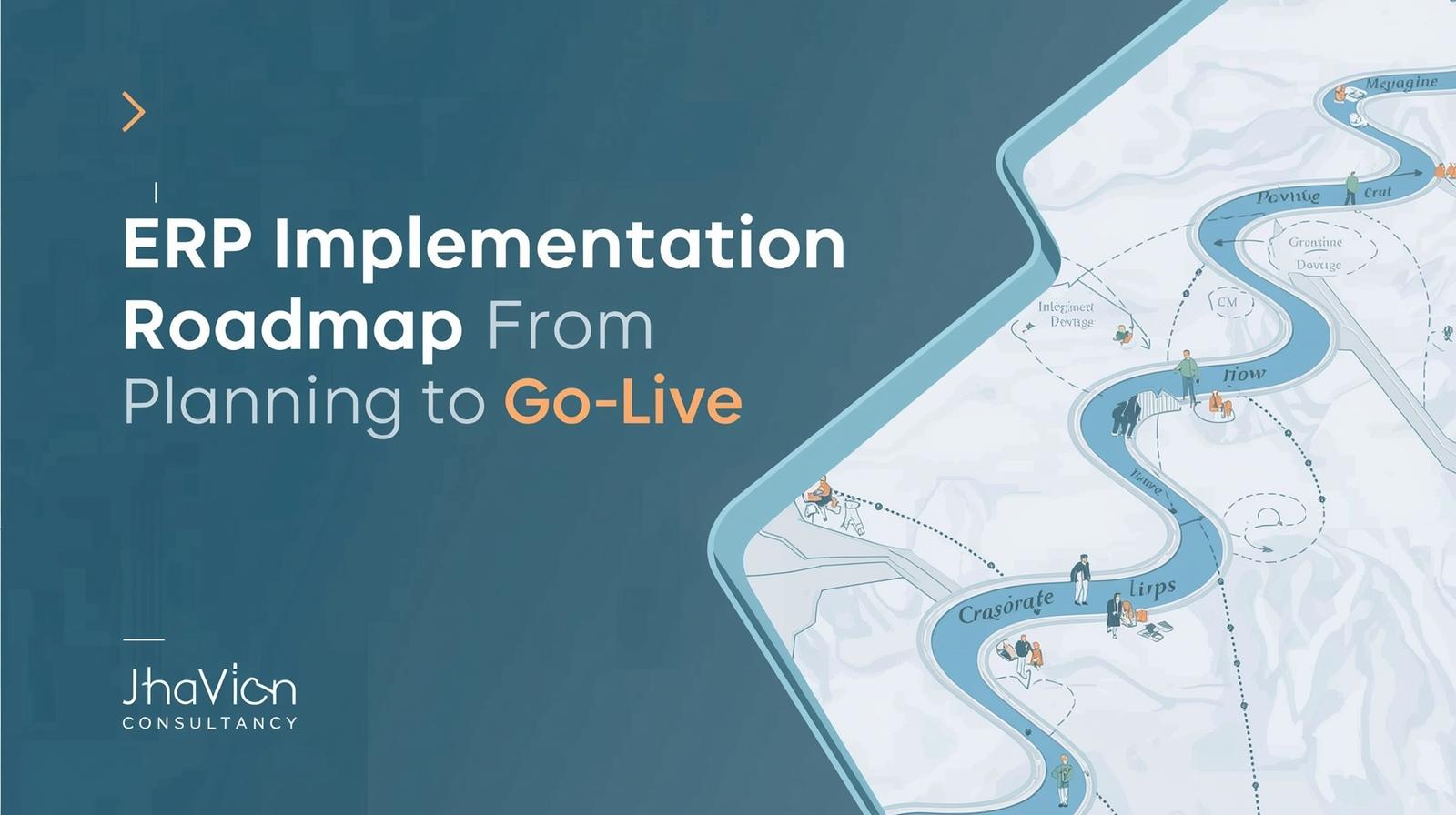

ERP Implementation Is a Journey, Not a Purchase
Many businesses think implementing an ERP system is about buying software, setting it up, and going live. In reality, ERP implementation is a strategic transformation journey — one that impacts every department, workflow, and decision.
At JhaVion Consultancy, we’ve seen two kinds of ERP projects:
- Those that succeed — because they follow a structured roadmap.
- Those that fail — because they rush into implementation without preparation.
If you want your ERP journey to bring lasting efficiency and ROI, this roadmap is your guide.
1. Planning & Project Preparation
Before diving into configuration, you need a solid foundation. This phase involves three critical actions:
a. Define Your Objectives
What’s the main goal? Better visibility, faster operations, cost control, or integration across departments?
Every ERP implementation should start with measurable objectives.
b. Identify the Project Team
Create a core ERP team that includes:
- Functional heads (Operations, Finance, Sales, Purchase, HR)
- IT team members
- A project manager (internal or external)
- A trusted ERP consultant (that’s where JhaVion steps in)
c. Set Timelines and Budgets
A clear plan avoids scope creep and unexpected delays. This phase is where we define milestones, dependencies, and realistic go-live targets.
👉 At JhaVion Consultancy, we start every project with a kickoff workshop that aligns all stakeholders on goals, roles, and expectations.
2. Business Process Audit & Requirement Gathering
Once planning is done, it’s time to understand how your business actually runs. We conduct a Business Process Audit — a detailed study of your current workflows, bottlenecks, and data systems.
This step ensures:
- You know what needs automation (and what doesn’t).
- The ERP configuration reflects your actual processes.
- The vendor doesn’t over-engineer or under-deliver.
Deliverables from this phase include:
- Business Process Document (BPD)
- Business Requirement Document (BRD)
- Process Flow Diagrams
These documents become the backbone of the ERP implementation roadmap.
3. Solution Design & Gap Analysis
Now that we know your business inside out, we design the ERP solution around it. This involves:
- Mapping each process to ERP modules
- Identifying functional gaps between your requirements and system capabilities
- Planning for customizations (only where truly necessary)
- Creating a data flow and approval matrix
At this stage, our consultants prepare a Functional Design Specification (FDS) — a document that defines how each requirement will be achieved in the ERP system.
👉 The goal here is clarity — zero ambiguity before configuration begins.
4. System Configuration & Customization
This is where the ERP software starts taking shape. The partner (or internal team) begins configuring modules based on approved designs — such as:
- Finance & Accounting
- Inventory Management
- Procurement
- Sales & Distribution
- Manufacturing / Production
- HR & Payroll
When gaps exist, we build custom modules or integrations using APIs and middleware tools.
At JhaVion Consultancy, we maintain version-controlled documentation at every step — so no customization gets lost or untracked.
5. Data Migration & Validation
Your ERP system is only as accurate as the data it runs on. Data migration is often underestimated — and it’s where many ERP projects face delays.
We follow a structured migration approach:
- Data Cleansing: Remove duplicates and outdated entries.
- Data Mapping: Match legacy data fields with ERP fields.
- Trial Import: Load sample data to validate accuracy.
- Final Migration: Import full data once tests are successful.
Pro tip: Never migrate everything blindly. Only carry forward what adds operational or financial value.
6. User Acceptance Testing (UAT)
Now comes the testing phase — where the system is tested by real users, not just consultants.
This step validates:
- Data accuracy
- Workflow logic
- Approval processes
- Report outputs
At JhaVion Consultancy, we guide teams through multiple UAT rounds to ensure every module performs exactly as intended.
Users identify any issues or improvements, which are then fixed before the final rollout.
7. User Training & Change Management
ERP success depends heavily on user adoption. If employees don’t understand the system, even the best ERP won’t deliver results.
We conduct role-based training sessions, focusing on:
- How each user interacts with their modules
- Common use-cases and exceptions
- Reporting and dashboard training
We also create user manuals and quick reference guides — making post-go-live adoption smoother.
Change management goes beyond training — it’s about helping your people see ERP as a growth tool, not a threat.
8. Go-Live & Post-Implementation Support
Finally — the big moment. Once UAT is signed off and data is validated, the ERP goes live.But this is not the end; it’s the beginning of real operational transformation.
In this phase, we focus on:
- Monitoring transactions in real-time
- Resolving early-stage issues
- Measuring KPI improvements
- Conducting post-implementation review
Our support doesn’t stop at go-live.
We provide stabilization support, performance monitoring, and monthly health checks to ensure everything runs as expected.
👉 At JhaVion, we treat go-live as “Day 1 of success” — not the end of delivery.
9. Continuous Improvement & Optimization
ERP systems should evolve as your business grows. Every 6–12 months, we recommend reviewing:
- New business needs
- Process bottlenecks
- Module usage analytics
By continuously auditing and optimizing, your ERP remains relevant and efficient — year after year.
Common ERP Implementation Pitfalls (and How to Avoid Them)
Even with a roadmap, there are common traps:
- Rushing without audit: Leads to poor configuration.
- Too many customizations: Makes upgrades difficult.
- Weak training: Causes low user adoption.
- No KPI tracking: Hard to measure success.
JhaVion Consultancy prevents these pitfalls with structured planning, documentation, and process-first consulting.
A Clear Roadmap = A Successful ERP Journey
ERP implementation is not about software installation — it’s about operational alignment.
A clear roadmap ensures your people, processes, and technology move together in sync.
At JhaVion Consultancy, we help businesses plan, execute, and stabilize ERP systems that actually deliver value. From process audit to post-go-live support, we stay with you at every step.
📞 Ready to plan your ERP journey the right way?
Connect with our ERP experts at www.jhavion.in or write to info@jhavion.in.
Don’t just implement ERP — implement success.
Book a free consultation with JhaVion Consultancy and get a personalized ERP Roadmap for your business. 📩 info@jhavion.in | 🌐 www.jhavion.in