
ERP Is No Longer Just Software — It’s an Engine of Digital Business
Enterprise Resource Planning (ERP) is evolving faster than ever. Today’s systems do more than automate transactions. They help businesses make smarter decisions, adapt to change, and stay competitive in complex markets.
Today they are evolving into intelligent, connected platforms that touch every part of your business. Today, it’s at the heart of strategic decisions, operational efficiency, and scalable growth.
But technology never stands still. Emerging innovations are reshaping what ERP can do — how it works, how it integrates, and how it drives value.
Business leaders aren’t just asking “What ERP should we buy?”
Now they’re asking:
“Which new ERP technologies will actually help us grow?”
or
Which ERP technologies are actually worth paying attention to?
The short answer:
Today’s ERP technologies being hyped right now are not just trends “new gadgets” or shiny “Add-ons”. They are tools that can fundamentally reshape, how your enterprise operate — but only when your business is ready for them.
In this Article, we unpack the top ERP innovations being hyped right now, explain why they matter, and discuss how to separate real value from buzz — so you avoid wasting time and money on trends that don’t align with your business goals.
Artificial Intelligence (AI) and Machine Learning (ML) in ERP
AI and ML dominate every ERP trend discussion—and for good reason. These are no longer futuristic concepts. They’re being embedded inside modern ERP systems to enable:
- Predictive demand planning
- Intelligent anomaly detection in financials
- Automated root-cause analysis of process bottlenecks
- Smarter supply-chain forecasting
- Natural language queries
For example:
- AI to predict stockouts before they happen, based on patterns of demand, lead times, and seasonal trends.
- ML can improve demand forecasting using historical data and seasonality
- Chatbots inside ERP can answer simple queries (e.g., available stock for product X) without human intervention
Reality Check for MSMEs
Not all businesses need advanced AI from day one. Real value comes when AI is:
- Linked to actual business problems
- AI works only when your data is clean, complete, and shared.
- Used to augment human decisions, not replace them
Many mid-market organizations still lack a single source of truth. That’s why AI success starts with process clarity and a strong ERP data strategy.
👉 Read Also : Top Signs Your Organization Isn’t Ready for AI Workflows
Internet of Things (IoT) & ERP Integration
IoT connects machines, sensors, and devices directly into your ERP. This is hyped because it enables:
- Smart sensors track machine cycles
- Real-time equipment status
- Automated trigger events (e.g., reorder points)
- Connected manufacturing dashboards
- Predictive maintenance for equipment
- Temperature/humidity logs for sensitive goods
- Barcode/RFID updates inventory in real time
In manufacturing, IoT sends real-time production and machine health data into ERP, helping teams prevent downtime. In warehousing, IoT sensors update inventory automatically, removing manual delays and errors. Together, this improves visibility, accuracy, and operational speed
Example:
A warehouse where incoming stock updates automatically the moment a pallet arrives, without a single human entry. That’s not futuristic anymore — it’s happening.
Reality check:
IoT creates value only when clear processes enforce accountability and the ERP system can interpret the data. Without defined ownership, sensor signals turn into noise instead of actionable insight
Low-Code/No-Code Extensions
Vendors are pushing low-code/no-code tools and app builders as part of ERP suites. Not every business need should require a developer. These tools allow teams to:
- Custom workflows
- Approval matrix changes
- UX tweaks
- Simple automations
- Create lightweight apps without developers
- Extend screens
This empowers:
- Business leads to contribute to system design
- Faster changes without long vendor cycles
- Lower dependency on expensive consultants
Low-code tools help tailor ERP systems to specific business needs. But here’s the problem: when processes aren’t clear, low-code development bakes complexity into the ERP core. Instead of fixing workflows, teams add workarounds. Over time, this creates ERP sprawl and technical debt.
That’s why low-code flexibility should support well-defined processes, not replace them. When platforms allow everyone to add custom logic without clear standards, ERP environments quickly become fragmented and difficult to maintain.
What this really means is simple:
Successful ERP customization starts with process clarity. Without it, low-code ERP platforms risk turning short-term speed into long-term chaos.
Cloud and Hybrid Deployment Models
Cloud ERP has been discussed for years. What’s changed is the architecture. The move to cloud-native, multi-tenant platforms is the real shift, and it explains why hybrid ERP models are gaining momentum.
Modern Cloud ERP delivers clear advantages:
- Faster implementation and deployment
- Automatic upgrades with minimal disruption
- Lower infrastructure costs through predictable, OPEX-based pricing
- Higher uptime and improved reliability
- Scalability that grows with the business
- Stronger, continuously updated security
- Subscription-based cost models
- Secure remote access for distributed teams
Hybrid vs Fully Cloud
Hybrid ERP exists because not every business can move fully to the cloud. Compliance requirements, data sensitivity, and complex operations often demand tighter on-premise control.
A typical hybrid ERP setup includes:
- Core ERP systems running on-premise
- Data lakes, analytics, or select modules in the cloud
- Sensitive or regulated processes kept on-premise
- High-volume analytics and dashboards handled in the cloud
The real advantage is balance. Companies retain control where it matters while still benefiting from cloud scalability and flexibility. For Indian MSMEs especially, cloud adoption reduces dependence on heavy IT infrastructure and large support teams. The payoff is lower costs, faster insights, and systems that scale with growth.
Why This Choice Matters
This shift directly impacts how organizations budget, secure, and scale ERP systems. Make the right deployment decision, and total cost of ownership drops significantly. The risk comes when companies go cloud-first and strategy-later. That approach leads to governance gaps, data sprawl, and growing complexity.
The rule is simple: decide what moves to the cloud and why before committing. Strategy first. Deployment second.
👉 Read Also : Cloud ERP vs On-Premise ERP — Which One Fits Your Business?
Embedded Analytics and Real-Time Dashboards
Embedded analytics is transforming how modern ERP systems support decision-making. While real-time reporting has existed for years, the real shift is the integration of analytics directly into ERP workflows. This change moves organizations away from static reports and toward real-time, actionable insights.
At its core, embedded ERP analytics delivers:
- Multi-dimensional, interactive dashboards
- Predictive analytics and trend forecasting
- Role-based dashboards for finance, operations, and leadership
- Drill-down analysis with action-triggered alerts
As a result, ERP dashboards now enable decisions based on insight rather than hindsight.
Why Embedded Analytics Matters in ERP
Here’s the key point: business leaders want insights, not reports. More importantly, they want those insights immediately.
Embedded analytics brings business intelligence capabilities natively into ERP platforms, eliminating the need for external BI tools. This includes:
- Drag-and-drop ERP dashboards
- Live KPIs and real-time performance metrics
- Multi-dimensional data slicing across departments
- Automated alerts for exceptions, thresholds, and anomalies
When implemented correctly, real-time ERP analytics:
- Identifies operational bottlenecks early
- Highlights cost overruns before they escalate
- Tracks clear OK / NOT OK performance indicators
- Enables faster, more confident executive decisions
The Risk of Real-Time Analytics Without Data Discipline
However, there’s an important caveat. Real-time analytics built on poor-quality data creates real-time confusion. Speed magnifies data issues instead of solving them.
To unlock the full value of ERP embedded analytics, organizations must first establish:
- Clean and validated master data
- Clear ownership of ERP processes
- Well-defined KPIs aligned with business objectives
Without these foundations, even the most advanced ERP dashboards fail to deliver meaningful insights.
Business Impact of Real-Time ERP Dashboards
Because of embedded analytics, business leaders no longer wait for monthly MIS reports. Instead, they access real-time answers that drive faster decisions and higher confidence.
Today’s ERP dashboards go beyond reporting. They support:
- Predictive insights for proactive planning
- Role-based views tailored to each function
- Deep drill-down analysis for root-cause discovery
- Actionable alerts that trigger immediate response
Ultimately, embedded analytics changes ERP from a system of record into a system of insight. The takeaway is clear: define your data, processes, and KPIs first. Once that foundation is in place, real-time ERP analytics delivers speed, clarity, and measurable business impact.
The Common Thread Leaders Must Understand
New ERP technologies promise intelligence, automation, and control. That promise is real, but only under the right conditions. But one truth stays constant:
Technology amplifies what already exists. It does not fix it.
Unclear processes lead AI to automate mistakes. Missing ownership causes IoT to surface confusion. Inconsistent data turns analytics into noise.
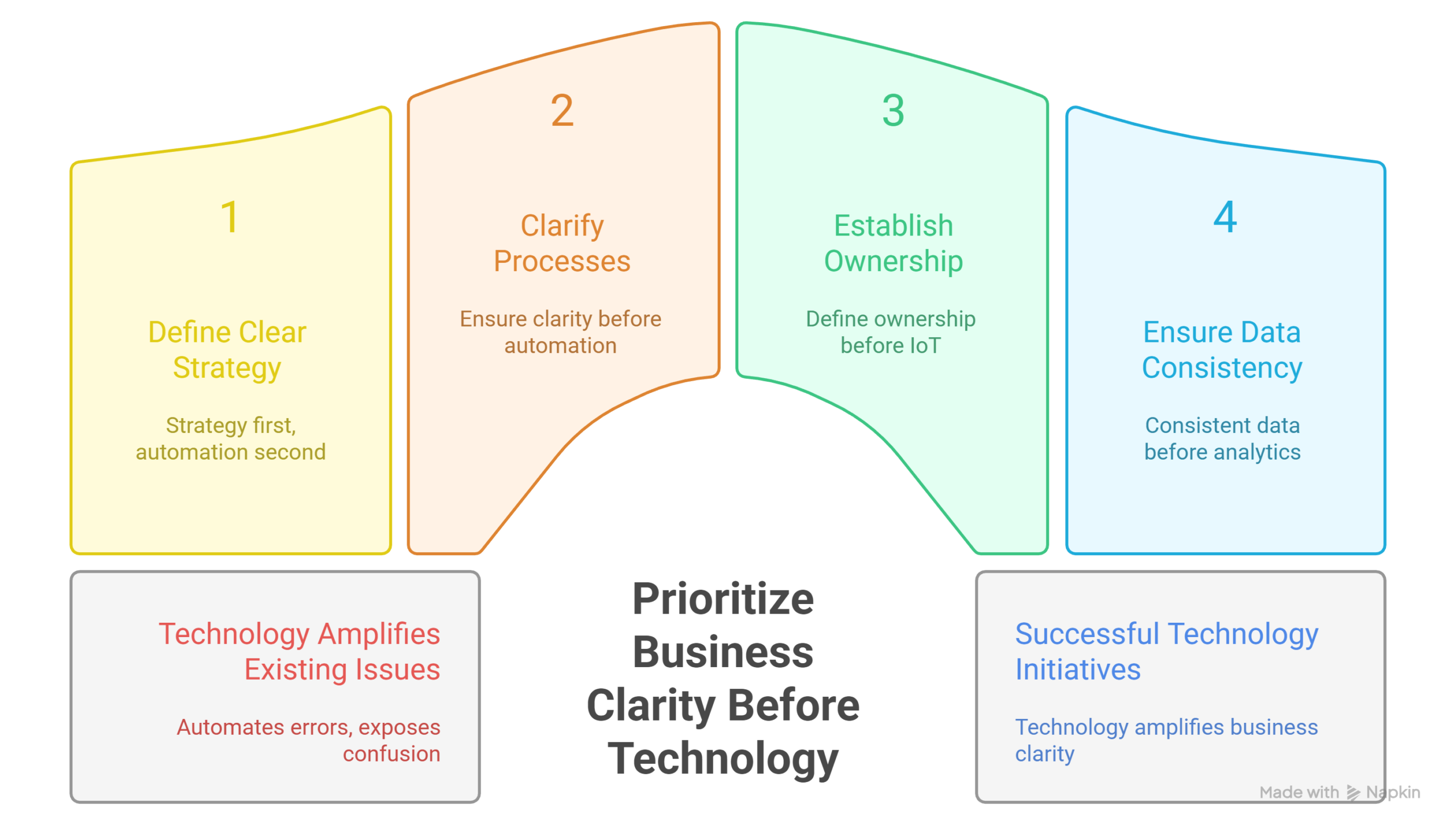
That’s why successful ERP initiatives don’t start with tools & technology. They start with business clarity, Define processes, accountability, and data first. Then let technology do its job.
How to Separate Real Value from Hype
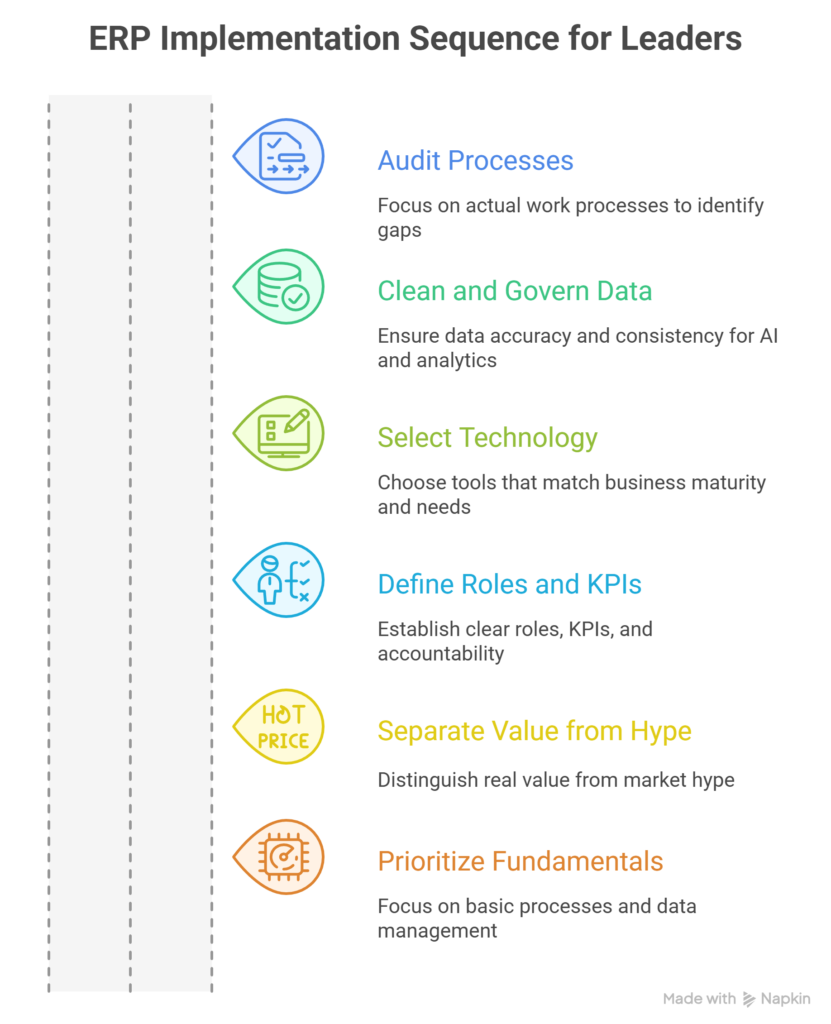
If you’re planning an ERP initiative—whether it’s a first-time implementation, a replacement, or a digital transformation—the sequence you follow will determine the outcome.
Here’s the trap many leaders fall into: assuming new technology equals better outcomes. That’s rarely true.
Start with process clarity. If workflows are broken, automation only scales inefficiency.
Then, match technology to real pain points, not market trends. If visibility isn’t your issue, advanced analytics won’t help.
At the same time, separate real value from hype. Always factor in total cost of ownership, including subscriptions, integrations, training, and long-term support.
For MSMEs especially, the priority should be fundamentals. Get the foundation right first. Without it, advanced ERP technology will fail. With it, even simple systems can drive meaningful results.
Final Thought: ERP Technology Should Empower, Not Distract
AI, IoT, RPA, cloud, and analytics aren’t magic solutions. They carry enormous potential, but only when organizations prepare for them properly.
Today’s ERP landscape is fast-moving and full of promise. Cloud-native systems, embedded analytics, automation, APIs—all of it can create real advantage. But here’s the reality: technology only works when it aligns with business clarity.
Strong processes turn innovation into impact. Weak ones turn it into cost, confusion, and rework.
At JhaVion Consultancy, we help leaders get this right. We work with business owners and decision-makers to:
- Identify which ERP technologies actually fit their needs
- Build a solid process and data foundation first
- Choose the right ERP model and tools
- Avoid expensive, hard-to-reverse mistakes
- Transform ERP into a business enabler—not just an IT system
Our ERP process audits ensure that when you adopt new technology, it delivers value immediately instead of distraction. The takeaway is simple: prepare the business before adding complexity. Do that, and ERP technology finally works the way it should.
Ready to Evaluate What’s Worth It for Your Business?
If you want a vendor-neutral perspective on ERP and new technologies — and how they can actually benefit your business:
🌐 www.jhavionconsultancy.in | 📩 info@jhavion.in
Let’s build a tech roadmap that drives value, not just hype.