
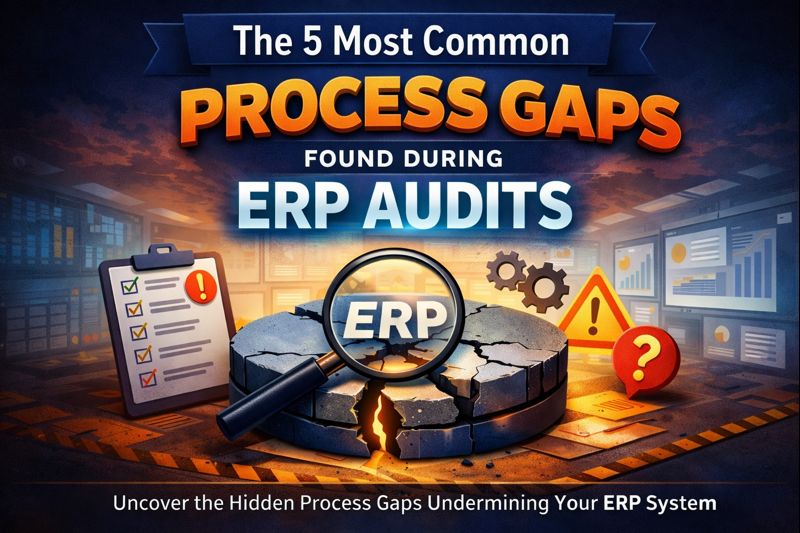

When an ERP system underperforms, most businesses immediately look at the software, the vendor, or the users. However, after auditing dozens of ERP environments across manufacturing, trading, and service-based businesses, we see one clear truth:
ERP failures rarely start in software.
They start in broken business processes.
At JhaVion Consultancy, ERP audits consistently reveal that the system work exactly designed. The problem lies in what businesses designed.
Let’s break down the five most common process gaps we uncover during ERP audits, why they silently damage performance, and how businesses can fix them before ERP failure becomes inevitable.
No One Owns the End-to-End Process
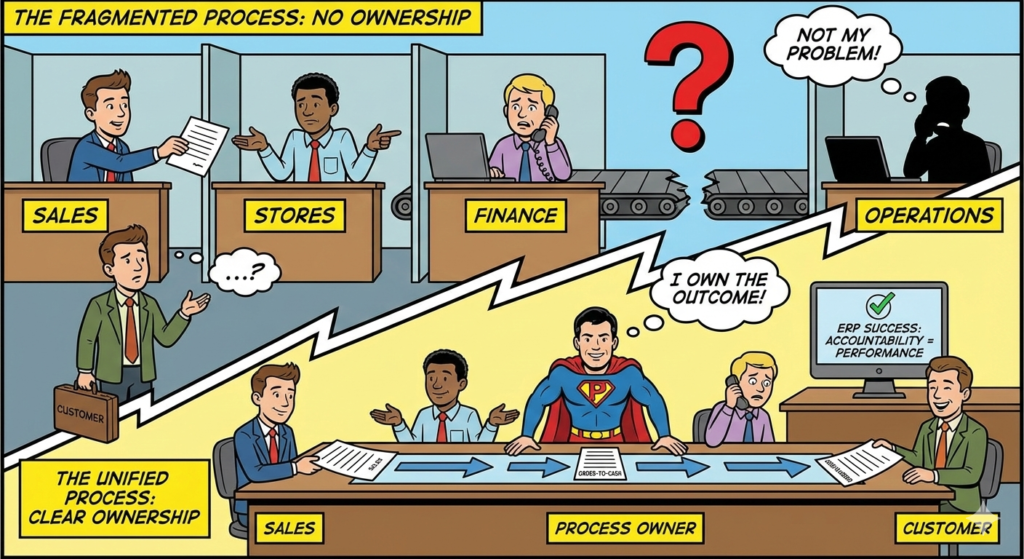
This is the most fundamental and most dangerous gap. In many SMEs, processes exist — but ownership does not.
For Example:
- Sales creates orders
- Stores dispatch materials
- Finance sends invoices.
- Operations handle exceptions and manage issues.
Yet nobody owns the full Order-to-Cash process. As a result, each team protects its own tasks, Meanwhile, nobody protects the outcome.
Because of this gap:
- Errors move between departments
- Delays go unnoticed
- ERP workflows break
- Customers feel the pain
During ERP audits, we often hear: “This part is handled by the other team.”
Therefore, ERP cannot deliver results without full ownership. Clear ownership creates accountability and if ownership is missing, accountability disappears and ERP becomes fragmented. If Accountability maintains that creates performance.
Lack of Standardization Across Teams or Locations
As businesses grow, variations creep into daily operations. Different departments, branches, and individuals handle the same activity in different ways. During ERP audits, we repeatedly find:
- Inconsistent approval logic,
- Multiple ways to create the same transaction, and
- Conflicting naming conventions for the same master data.
Over time, these inconsistencies create duplicate records, broken reports, and widespread user confusion.
ERP systems depend on standardization. When businesses resist aligning on standard processes, the ERP either becomes overly rigid or descends into chaos. This gap usually signals one thing: the business has grown faster than its process maturity.
Processes Exist Only in People’s Heads
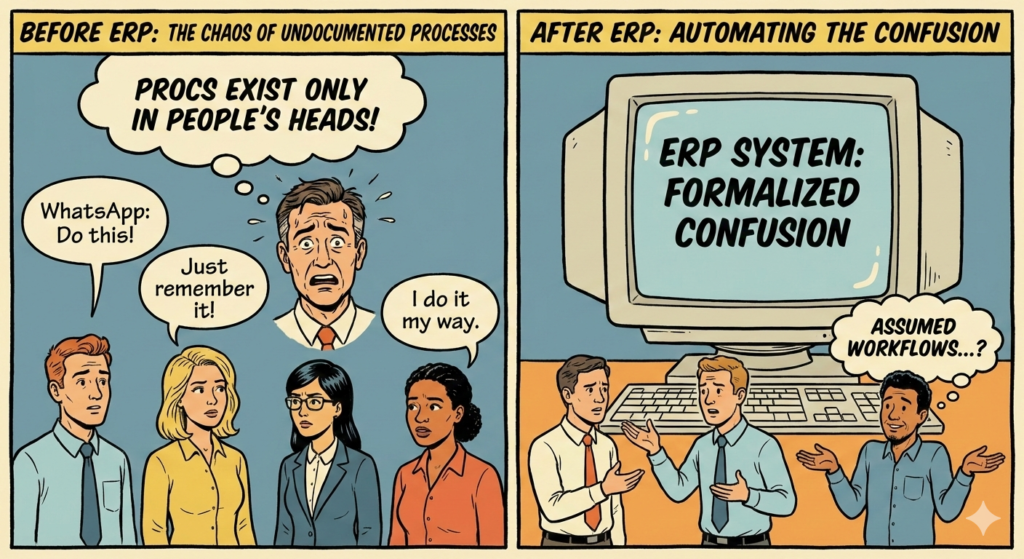
Another critical gap is the absence of documented processes. Many businesses never documented their processes they rely on memory instead of structure.
Processes are communicated verbally, manage them through WhatsApp messages, or carry different interpretations in their heads. This approach works when teams are small. It breaks down the moment an ERP system demands consistency.
During ERP audits, we repeatedly see the same issues:
- Teams never documented AS-IS processes
- Leadership never formally defined TO-BE processes
- The ERP system became the first place where anyone tried to define how work should happen
As a result, ERP vendors guess at workflows, users interpret steps in their own way, and exceptions multiply. ERP systems should automate processes that teams already understand and agree on. When organizations fail to document their processes first, the ERP doesn’t fix confusion. It locks it in.
Exceptions Are Handled Outside the System
Most ERP implementations design for ideal scenarios where everything goes according to plan. Real businesses don’t operate that way. They run on exceptions. Real operations include:
- Urgent orders,
- Partial deliveries,
- Pricing changes,
- Stock shortages, and
- credit holds
- Emergency approvals.
During ERP audits, we consistently see teams handling these situations outside the system through emails, phone calls, or manual workarounds.
This behavior weakens internal controls, increases reliance on specific individuals, and creates audit risk. ERP systems perform best when teams design exceptions into the workflow instead of bypassing the system altogether.
Processes Are Not Linked to Decision-Making
One of the most damaging gaps we see is the disconnect between processes and management decisions.
In many organizations, the ERP captures data and produces reports, yet leadership hesitates to trust them. That hesitation comes from a simple problem: teams designed processes without thinking about the decisions management needs to make.
When processes don’t support decision-making, reports feel academic and dashboards lose credibility. The ERP turns into a transactional system instead of a strategic one, which defeats its core purpose.
Why These Process Gaps Remain Hidden for So Long
Most businesses don’t ignore process gaps on purpose. These gaps persist because the ERP appears to work on the surface, teams compensate with workarounds, and losses build up slowly.
By the time leadership feels the impact, margins are under pressure, productivity has fallen, and trust in the ERP has already eroded. At that point, many organizations look to replace the system instead of fixing the underlying issues.
Replacing the ERP without closing the process gaps doesn’t solve the problem. It just restarts the cycle.
How ERP Audits at JhaVion Consultancy Create Clarity
ERP audits at JhaVion Consultancy are not technical checklists. They are business diagnostics designed to uncover the real reasons ERP struggles.
We focus on
- How work actually happens,
- Where ownership breaks down,
- How ERP aligns with real operations, and
- How process gaps impact cost, control, and decision-making.
Our audits provide clear priorities by identifying what needs immediate correction, what can be optimized later, and what should remain unchanged.
Across industries and geographies, one insight keeps proving itself. When teams fix process gaps, ERP issues drop sharply, often without any major system changes. That’s why process audits sit at the foundation of ERP rescue, ERP optimization, digital transformation, and ERP selection.
ERP Can Never Be Better Than the Process It Runs On
ERP systems don’t create discipline. They reveal where discipline is missing.
When an ERP feels complex, slow, or unreliable, hidden process gaps usually sit beneath the surface, quietly eroding its value. The good news is this: these gaps are fixable when teams identify them early and address them systematically.
At JhaVion Consultancy, we help businesses uncover those gaps, realign ERP with how work actually happens, restore trust in systems and reports, and turn ERP into a growth enabler instead of a daily struggle.
Ready to Identify the Process Gaps in Your ERP?
If you are unsure why your ERP has not delivered clarity or where inefficiencies are coming from, an honest ERP and process audit is the right place to start.
🌐 www.jhavionconsultancy.in | 📩 info@jhavion.in
Fix the process, and ERP performance follows.