
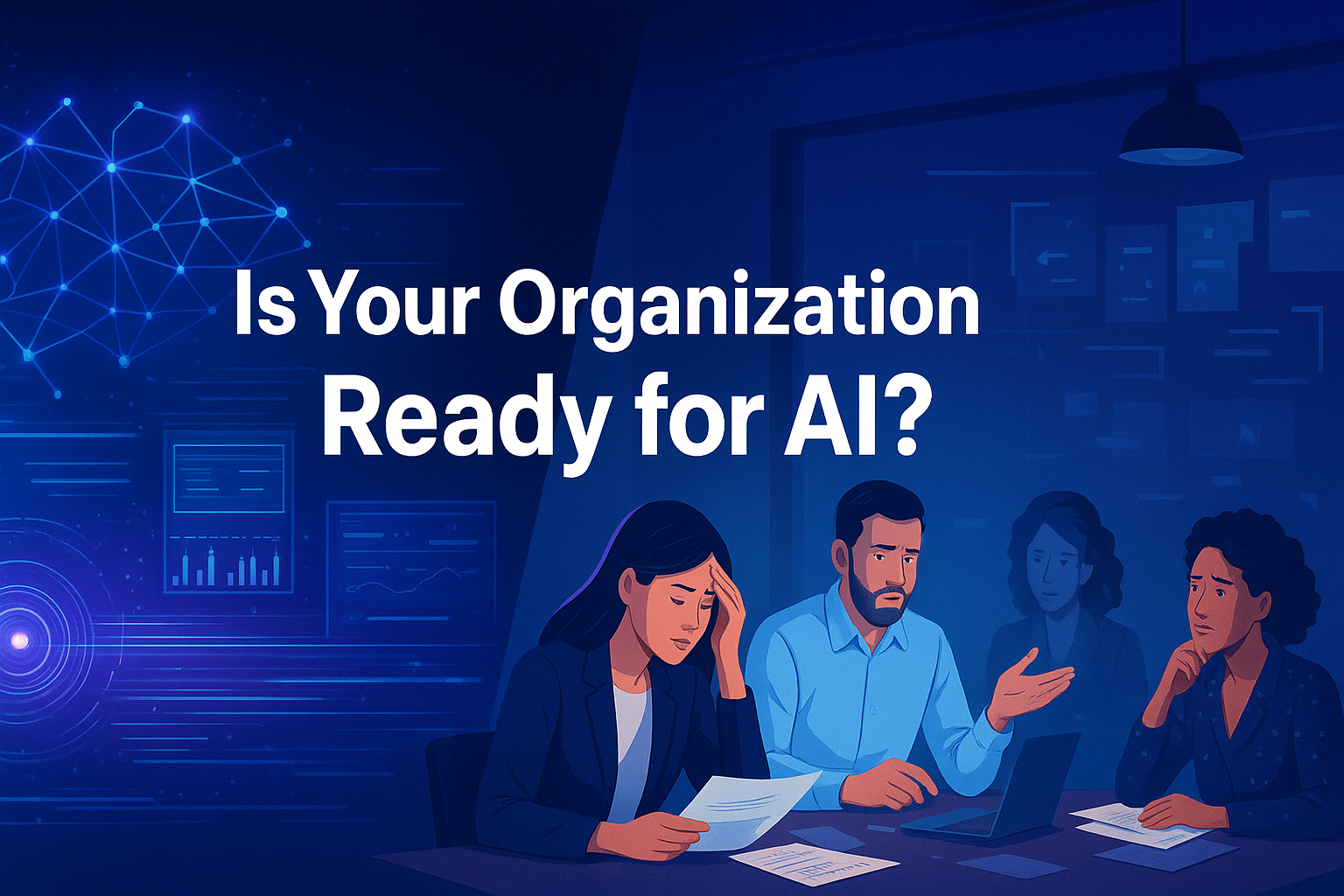

Artificial Intelligence is evolving at a blistering pace. Tools are becoming smarter, APIs are becoming more accessible, and enterprises feel increasingly pressured to take the leap. Yet the real obstacle isn’t the technology. It’s the organization behind it. Many companies discover—too late—that while they purchased AI platforms and signed up for automation tools, their internal culture, processes, and people are far from ready to adopt them.
AI success depends on more than deploying a model or integrating an app. It demands a mindset shift, structural maturity, disciplined processes, and a strong appetite for data-driven decision-making. When those foundational elements are missing, even the most advanced AI investment stalls. Understanding these red flags early helps business leaders avoid costly failures and prepare teams for sustainable transformation.
Teams See AI as a Fancy Add-On Instead of a Core Business Capability
Companies often enter the AI journey with a narrow mindset. Instead of viewing AI as a strategic capability that reshapes decision-making, productivity, and innovation, employees see it as a gadget. This mindset limits adoption immediately.
When people believe AI is “extra,” they treat it as a temporary tool rather than a transformative extension of their daily workflow. That perception slows usage, increases resistance, and sends AI projects into the familiar “proof-of-concept loop,” where nothing moves into production.
No One Clearly Owns AI Strategy or Accountability
AI initiatives collapse quickly when ownership is vague. Without a designated leader or cross-functional governance team, implementation becomes scattered. Departments experiment in isolation, vendor decisions lack alignment, and communication breaks down.
Creating AI workflows requires coordination between business teams, IT, operations, and leadership. If there is no structure guiding the program, each unit moves at its own pace. That mismatch creates confusion, slows innovation, and ultimately prevents AI from scaling.
Employees Fear AI Will Replace Their Jobs Instead of Enhancing Their Work
Fear is the silent killer of AI adoption. When employees hesitate to use automation tools, productivity drops and collaboration suffers. This resistance rarely comes from lack of skill—it comes from lack of security.
People fear the unknown. They assume automation means downsizing. They hold back their knowledge, avoid training sessions, or decline to participate in workflow redesign. Unless leadership communicates clearly and repeatedly that AI will augment—not replace—human effort, adoption runs into immediate cultural friction.
Processes Are Broken, Inconsistent, or Poorly Documented
AI cannot repair chaos. When business processes differ from team to team, lack documentation, or operate purely on “tribal knowledge,” automation becomes nearly impossible.
Before any AI workflow can succeed, foundational operations must be consistent, measurable, and stable. If your teams still depend on manual approvals, undocumented steps, or outdated SOPs, the organization will struggle to introduce automation without breaking daily operations.Short Description
Data Exists Everywhere, but No One Trusts It
Companies generate huge volumes of data, yet they often struggle to trust or use it. AI adoption becomes risky when employees lack confidence in the accuracy, completeness, or source of information.
Poor-quality data leads to incorrect predictions, flawed recommendations, and user frustration. As trust erodes, engagement drops. No one wants to rely on insights they believe are flawed. AI readiness requires a strong foundation of data governance, transparency, and accessibility.
Leadership Still Makes Decisions Based on Intuition Instead of Insights
AI thrives in environments where leaders embrace evidence. However, many organizations still rely heavily on gut feeling, historical preferences, or personal judgment. Although experience matters, decisions that ignore data weaken AI’s role and diminish its value.
When leaders bypass dashboards, ignore predictions, or override analytics without justification, teams notice. They assume the insights don’t matter and stop engaging with the tools. Organizational readiness demands a cultural shift toward data-backed decision-making.
Training and Upskilling Are Treated as Optional
AI literacy is no longer optional. Teams need practical skills—not just theoretical knowledge—to redesign workflows and collaborate with automation tools. Yet many organizations skip formal training because they “don’t have time” or assume AI is self-explanatory.
That assumption leads to underutilized systems, inconsistent usage, and misunderstanding of AI’s capabilities. Without structured upskilling in prompt design, data interpretation, and workflow thinking, the organization will not gain meaningful value from its AI investment.
Departments Operate in Silos and Resist Sharing Information
AI thrives on integrated data flows and cross-functional collaboration. When departments guard information, limit access, or resist cooperating with other units, AI workflows suffer. Silos restrict the models’ ability to learn, block automation pipelines, and hinder real-time decision support.
Breaking these barriers demands strong leadership, shared KPIs, and a unified strategy that encourages teams to collaborate instead of competing internally.
The Organization Has No KPIs, Metrics, or Success Framework for AI
Without clear objectives, AI success becomes subjective. Teams struggle to explain ROI, leaders hesitate to invest further, and automation pilots lose momentum.
Every AI initiative must start with measurable expectations—reduction in cycle time, improvement in accuracy, increase in customer satisfaction, or savings in operational cost. When metrics are missing, the organization cannot track impact, optimize workflows, or justify expansion.
Leadership Expects Overnight Transformation
Many executives assume AI works instantly because tools appear simple. Although interfaces are accessible, the transformation behind them is complex. Setting unrealistic timelines becomes a major source of burnout and project failure.
Proven AI adoption requires experimentation, iteration, and continuous change management. Organizations that expect “30-day magic” overlook the deeper cultural and operational changes needed to support automation long-term.
AI Readiness Is More About Culture and Operations Than Technology
The biggest misconception about AI is that readiness depends on software. Technology is the easiest part. Organizational maturity is the real differentiator.
Companies that succeed with AI build three core strengths:
- strong process discipline
- high trust in data
- collaborative, empowered, confident teams
When these elements are present, AI becomes a strategic advantage. Without them, even the best tools sit unused.
Prepare Your Organization Before You Deploy AI
If these warning signs resonate with your organization, this is the moment to step back and build the right foundation.
Strengthening culture, realigning processes, and improving data discipline will dramatically increase the return on any AI investment. A structured approach ensures implementation stays stable and scalable.
Ready to Evaluate Your AI Readiness?
We offer a comprehensive AI Readiness & Workflow Transformation Audit designed specifically for organizations looking to elevate performance with intelligent automation.
You receive:
✔ a clear maturity score
✔ workflow improvement opportunities
✔ data readiness analysis
✔ cultural adoption assessment
✔ a roadmap for AI-powered operations
📩 Schedule your free pre-audit conversation and discover where your organization truly stands.